

By Correspondent
The effects of the ongoing Gulf War did not take long to be felt in Zimbabwe.
What many thought would be movie-style entertainment of two adversarial countries having a go at each other turned into real-life complications for every economy, Zimbabwe included.
The cost of living has gone up, owing to disruptions in crude oil production and its distribution.
Consequently, fuel prices have gone up, as has happened across the whole world.
Currently in Zimbabwe, petrol is retailing at US$2.17 per litre, while diesel is pegged at US$2.05.
Government taxes, which were long decried to be too high, were also increased, as if they originated from the contentious Strait of Hormuz.
In their justification, Zimbabwean authorities said they want to build strategic reserves at the cost of about 86 cents for every litre of fuel.
Fuel is one of the major cost drivers; bread prices have gone up, and household goods have followed suit.
Lives Complicated By A War Far Away
This situation, which looks like it will prevail for some time, has complicated lives for Government workers and the rest of the country’s underpaid workforce, whose meagre salaries are difficult to survive on.
A person who commutes from Harare Central Business District to Southlea Park now needs an average of $3 per day as trip fares have risen from 50 cents and a dollar to US$1.50.
For Chitungwiza commuters, the circumstances are even worse; they have to say silent prayers as they approach their ranks. Depending on which side of the bed kombi operators wake up on, fares can go as high as US$2.50.
At a daily transport rate of US$5, this means a nurse who works in and around the Central Business District would need to spend $100 on transport alone.
On a salary of less than $300, this translates to almost a third of their earnings, before adding other responsibilities.
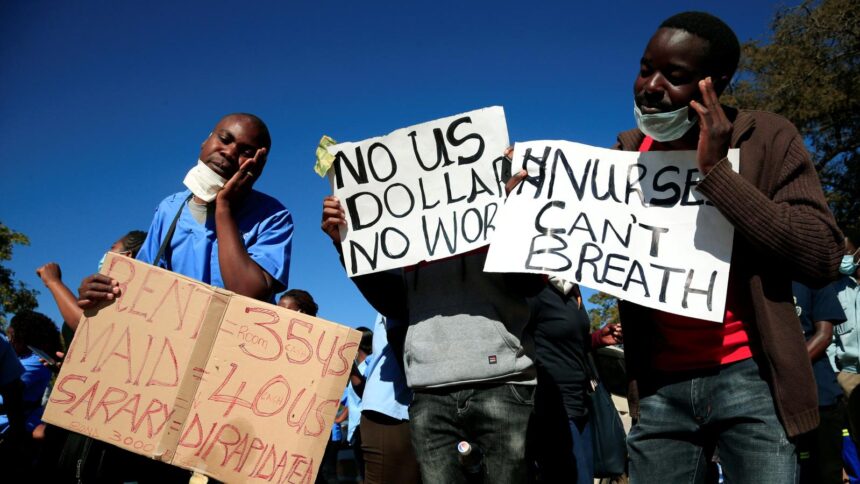
It is this basic math and other issues which have compounded to see nurses downing tools at two of the country’s largest referral hospitals, Parirenyatwa and The Sally Mugabe Group of Hospitals.
While at face value this looks like another episode in the never-ending tale of Government and its employees confronting each other once every full moon, this time nurses to have a legitimate claim; one our administration cannot afford to ignore.
What Do Nurses Want and What is Government Saying?
Nurses have laid their cards on the table; they are decrying the present while looking into the future.
In the most recent notice, they gave the government three weeks to look into their welfare.
According to a notice to strike released by the Zimbabwe Nurses Association, nurses are demanding an immediate review of their remuneration and an adjustment to their pensions, to ensure their post-retirement payout.
The government has not given a direct response to the nurses’ concerns.
Instead, the Minister of Public Service, Labour and Social Welfare, Edgar Moyo, gave a blanket press statement promising that effective 1 April 2026, there will be adjustments to all civil service salaries.
Minister Moyo did not share figures, but promised a review that is sensitive to the realities of civil servants.
Last time there was an adjustment to civil service salaries, the effects were barely felt.
If he achieves what he promises, he will be the first Labour Minister since 2013 to give nurses a decent life, outside of benevolence by well-wishers.
A long history of failure
The country’s administration has failed to adequately provide resources for the health sector.
Since 2008, when nurses went on strike over poor working conditions and the cholera epidemic, there have been seven major strikes.
In 2008, the cholera outbreak coincided with the collapse of the Zimbabwean dollar.
With a salary whose buying power would be eroded within hours and increased pressure through the worst ever cholera outbreak this country had recorded since 1980, the nurses declared incapacitation.
During the coalition Government, some form of stability prevailed, and most civil servants got nostalgic over the good old days as they were earning good salaries in the region of $580 per month, something they yearn to return to.
Another major strike was to follow in 2018, where then Acting President Chiwenga fired 16 000 nurses in one stroke of a pen.
These nurses had downed their tools citing incapacitation, Government announced a salary increase, but it barely moved the needle, and nurses refused to budge.
The government announced the firing of the nurses, only for them to be reinstated after realising how the hasty move had further collapsed the already ailing health sector.
In 2020, billionaire Strive Masiyiwa had to intervene, providing doctors with free transport and a monthly allowance, after healthcare workers
Between then and now, there have been minor strikes, usually resolved within a day or two, but the current one looks like a different calibre from the ones the country has experienced.
Real life implication
The challenge with nurses’ strikes is that there is nothing like a small strike.
When a nurse is lethargic or derelict in duty, a suffering citizen suffers.
No one goes to a public referral hospital for sightseeing; these are taxpayers banking on the government to save their lives.
When nurses are not guaranteed, it becomes a betrayal of not only the citizens’ trust in public institutions, but their country, failing to provide service in a deep moment of need.
The way our public hospitals are structured, nurses carry the weight of service of provision as primary health care providers. They are the first responder,s and it is usually their discretion and expertise that draws the line between life and death.
Their absence in a hospital ward, even for minutes, can prove dire to ordinary citizens, who, unfortunately, cannot whisper to whatever illness they may be facing, explaining the circumstances.
There are thousands reliant on the same nurses for critical procedures like dialysis, cancer treatment and surgeries.
The other potential effect, often overlooked is how public service efficiency is very difficult to regain once lost.
When the quality of service drops due to grievances between employee and employer, those participating in the job action will not miraculously start being effective at their jobs.
Every time there is a strike, it chips away into the very core of service delivery and a part is not regained.
The country’s civil service is already plagued with lethargy and these workflow disruptions may worsen matters.
Is There a Solution?
The Zimbabwean Government cannot get away with paying people low wages.
Currently, there is a remuneration review underway, but no one is holding their breath.
Early signs have shown that it will likely be a marginal increase.
This will potentially be swallowed by the ongoing geopolitical-induced economic shifts.
Finance Minister Professor Mthuli Ncube recently told Parliament that the Government is ‘seized’ with improving conditions of work for civil servants.
At this moment, one hopes this is one of the few times top officials actually say what they mean, unlike in other instances.
———————————————————————————————————-
Love what we do? We’re dedicated to opening up democracy, one article, video and story at a time. If you find our reporting helpful, you can support the Magamba Network team by buying us a coffee. It’s quick, easy, and makes a real difference!
————————————————————————————————————