

By Correspondent
Whenever there is a gathering involving senior officials from the Ministry of Local Government and Public Works, a warning is issued to those buying rural land through local headmen (sabhukus).
The argument is the same: ‘all rural land is vested in the President, and therefore it cannot be sold.’
This is premised on Section 4 of the Communal Lands Act, which vests all rural land in the President’s hands.
Despite the regular reiteration of this well-known legal fact, development continues, and peri-urban sprawl continues unabated.
Can policy afford to remain rigid in the face of reality?
How Did We Get Here?
Zimbabwe has an acute housing crisis, one that has been allowed to fester over the years with no solution in sight.
Harare alone is said to have a waiting list with over 200 000 prospective home owners.
In the face of municipal inactivity, the role of land development has been left in the hands of private developers. These developers have in turn, priced residential stands beyond the reach of many.
On average, land in Harare costs an average of $60 per square metre.
To buy 200 square metres, which is usually the smallest possible stand size, a civil servant earning $280 would need 43 months without touching a single cent off their salary.
Despite that level of sacrifice, there is no guarantee of the legitimacy of the land in question; every other day, there is a case involving residential stands in any of the country’s courts.
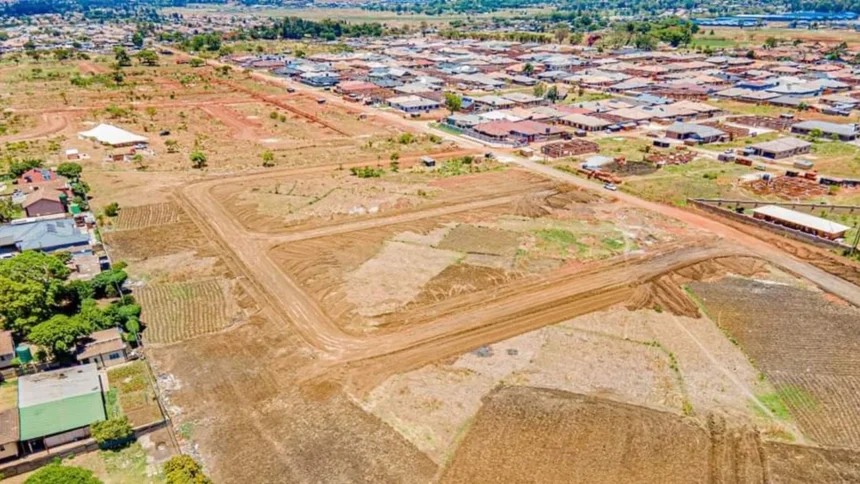
The cost of land and the chaos around access have pushed people to resort to rural areas surrounding big cities.
Maybe integration is the solution
The quality of infrastructure being built in these peri-urban areas shows a citizenry whose appetite for development has evolved faster than that of the country hosting them.
Despite the difficult economic conditions that many are operating under, Zimbabweans have been investing in building modern houses.
Some properties in areas like Goromonzi or Dema can be transposed to areas like Arlington and fit seamlessly.
Where people have shown such an appetite, it may be better to engage them and collectively find a sustainable way to improve their living conditions.
We hope they are being for real this time
In this week’s cabinet update, there was some indication that the government is considering a plan that will regularise informal settlements.
Although not much detail was shared, they hinted at accelerating the regularisation of informal settlements through providing essential infrastructure under what they are terming a User-Pay Principle.
Unless the definition is reinvented, which is not a remote possibility, a User-Pay Principle simply means that the beneficiary will have to pay for the setting up of the infrastructure.
Of humanity, dignity and human rights
Why the solution must be sustainable….
Power utility ZESA has led the way and can share the model with peers.
ZESA have been relatively more receptive towards informal settlements.
Domboshava has taken a life of its own; it is now a peri-urban settlement which cannot be wished away.
———————————————————————————————————-
Love what we do? We’re dedicated to opening up democracy, one article, video and story at a time. If you find our reporting helpful, you can support the Magamba Network team by buying us a coffee. It’s quick, easy, and makes a real difference!
————————————————————————————————————