

By Correspondent
The City of Harare has stepped up efforts to address one of its biggest sources of water pollution, with repair works on a 2.6-kilometre main sewer pipeline set to begin within the next 30 days.
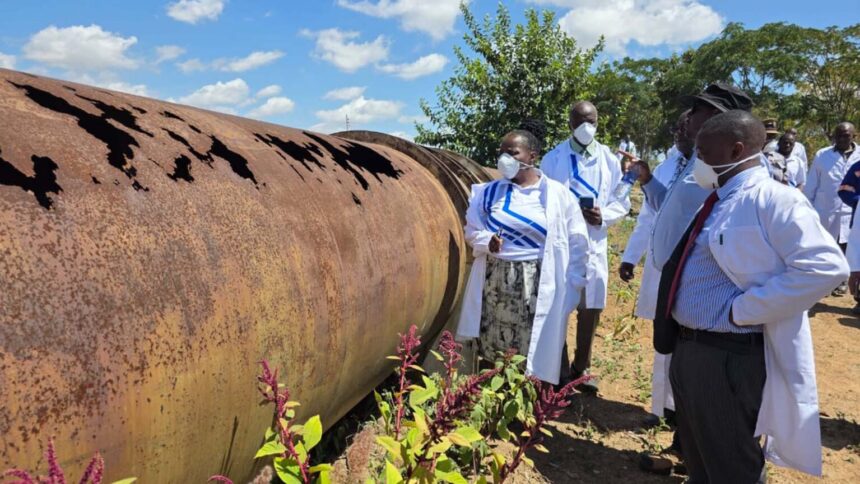
Harare Mayor Jacob Mafume yesterday toured a damaged section of the city’s main sewer network at Amalinda Stream Crossing.
The visit brought to attention the scale of infrastructure failure driving pollution into Lake Chivero.
The inspection centred on a 2.6-kilometre stretch of a critical trunk sewer line linking the Simon Mazorodze Road corridor to the Firle Sewer Treatment Works.
This is a key route for conveying wastewater across the capital.
What the delegation encountered was a severely degraded system.
According to city officials, the ageing pipeline is discharging an estimated 80 megalitres of raw sewage into Lake Chivero every day.
This is contaminating Harare’s primary water source and compounding already high water treatment costs.
The pollution flows through the Mukuvisi River before reaching the lake, effectively turning sections of the river into channels for untreated waste.
City authorities say rehabilitation works on the pipeline are expected to begin within the next 30 days.
They will be funded through government devolution funds and carried out by Watermark Technologies.
Materials for the project have reportedly already started arriving.
The intervention is expected to address a significant share of the untreated sewage entering Lake Chivero.
The development could bring some relief to a system under strain.
A Wider Problem
However, the Amalinda pipeline is only one part of a much wider problem.
Harare’s sewer infrastructure, much of it built decades ago, has struggled to keep up with rapid urban expansion.
Frequent pipe bursts, blockages and overflows have become common, often leaving raw sewage flowing into open spaces and water bodies.
Even when wastewater reaches treatment facilities such as the Firle Sewer Treatment Works, capacity constraints and ageing equipment mean not all of it is adequately treated.
Beyond ageing infrastructure, the tour also exposed another challenge, the proliferation of illegal settlements and gardening activities along and directly above sewer lines.
Mayor Mafume warned that such developments have worsened pipe damage and could obstruct repair work.
He indicated some structures may have to be demolished as part of a “painful but necessary” process to restore the system.
The situation reflects broader urban planning challenges.
Housing demand has outpaced formal planning, pushing some residents into environmentally and technically unsuitable spaces.
Mayor Mafume also highlighted cooperation between the City of Harare and the central government, noting ongoing infrastructure partnerships.
“Government is one, and we must put aside political differences and work together as Zimbabweans to allow development,” he said.
Health Concerns
The continued discharge of untreated sewage into Lake Chivero raises serious public health concerns.
The lake supplies most of Harare’s drinking water.
This means pollution at source translates into higher purification costs and increased risk of contamination.
Zimbabwe has previously experienced major disease outbreaks linked to poor sanitation, including the 2008 Zimbabwe cholera outbreak.
Health experts have consistently pointed to failing sewer systems and contaminated water as key drivers of such crises.
Environmentally, the influx of waste has contributed to the degradation of Lake Chivero, including nutrient pollution that fuels algae blooms and disrupts aquatic ecosystems.
City officials have pointed to collaboration between the council, the central government, and private contractors as critical to addressing the crisis.
Partnerships linked to infrastructure upgrades and waste management are already underway, as authorities attempt to stabilise key systems.
Years of underinvestment, limited maintenance, and weak enforcement of urban planning regulations have allowed critical infrastructure to deteriorate to this point.
The current intervention, while significant, highlights the cost of delayed action.
The rehabilitation of the Amalinda pipeline represents a key test for Harare’s ability to respond to its infrastructure challenges.
If successfully implemented, it could significantly reduce the volume of untreated sewage entering Lake Chivero.
For residents, the stakes are high, from the safety of their drinking water to the long-term sustainability of the city’s environment.
———————————————————————————————————-
Love what we do? We’re dedicated to opening up democracy, one article, video and story at a time. If you find our reporting helpful, you can support the Magamba Network team by buying us a coffee. It’s quick, easy, and makes a real difference!
————————————————————————————————————