

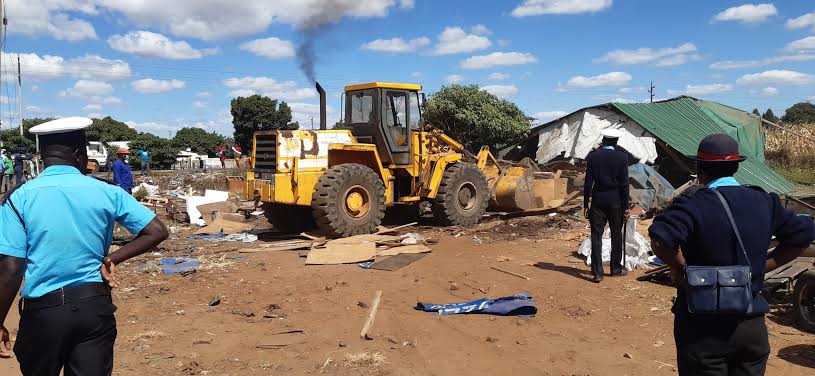
By Correspondent
Zimbabwe’s campaign against street vending has unfolded in waves for more than two decades.
The names have changed, the authorities involved have changed, and the stated objectives have varied from restoring order to public health and urban regeneration.
But the underlying problem has proved remarkably persistent.
May 2005 — Operation Murambatsvina
Announced/launched: May 19, 2005.
Who: The central government, with the operation jointly organised by the Local Government Ministry, Home Affairs Ministry, police, the Harare Commission and the Harare provincial administration.
The official launch took place at Harare Town House, where Commission chair Sekesai Makwavara announced the operation.
Main objective: Clear informal settlements, illegal structures and informal businesses, including street vending, in the name of restoring order and enforcing planning regulations.
Outcome: The operation achieved an extensive physical clearance, but its social and economic consequences were severe. The UN estimated that about 700,000 people lost homes, livelihoods or both.
It demonstrated the state’s capacity to clear urban areas rapidly, but did not eliminate the informal economy that generated street vending.
February–July 2015 — The Clean-Up Campaign and Seven-Day Ultimatum
Announced: February 4, 2015, with another major directive issued on June 1 and enforcement intensifying in July.
Who: Local Government Minister Ignatius Chombo launched the clean-up campaign in February.
On June 1, Chombo issued a seven-day ultimatum requiring vendors to move to designated sites.
His successor, Saviour Kasukuwere, subsequently announced that he would ensure the relocation of an estimated 20,000 unlicensed vendors.
Main objective: Remove vendors from pavements, intersections and other undesignated areas and move them into designated vending sites.
Outcome: Municipal police carried out raids, confiscations and arrests. By the end of 2015, however, the campaign was already facing resistance, with Harare City Council halting the clampdown after prolonged confrontations with vendors.
February 2016 — Mbudzi and Market Relocation Campaign
Announced: Early 2016.
Who: Harare City Council, operating under the broader national and municipal push to move vendors from undesignated areas.
Main objective: Move traders from places such as Mbare and Mbudzi into designated markets, partly in response to public-health concerns including a typhoid outbreak.
At Mbudzi, council attempted to move traders into the newly constructed Mbudzi People’s Market.
Council also considered forcibly moving traders from Mbare to Tsiga before opting for a more gradual process.
Outcome: The relocation model struggled because vendors questioned the location, infrastructure and commercial viability of alternative sites. Complaints of corruption involving municipal police also emerged.
September 2018 — Cholera-Driven Vendor Raids
Launched: September 15, 2018.
Who: Harare City Council and the Zimbabwe Republic Police.
Main objective: Decongest the CBD and address public-health concerns during the cholera outbreak.
Police and council officers raided vendors in central Harare after appeals for traders to leave the streets had failed.
Outcome: Vendors temporarily abandoned some trading points, but the intervention did not permanently remove informal trading from the CBD.
April 2020 — COVID-19 Lockdown Demolitions
Launched: April 2020, during the first national COVID-19 lockdown.
Who: Harare City Council, operating within national lockdown regulations and a government directive to clean up and renovate workspaces used by SMEs and informal traders.
Main objective: Remove illegal vending structures while authorities were also attempting to control crowded trading areas during the pandemic.
Council demolished stalls in Mbare, Highfield and other high-density areas. It said affected vendors would be relocated.
Outcome: Hundreds of informal traders lost trading structures during a period when movement and economic activity were already severely restricted.
June 2021 — Harare–Chitungwiza Demolitions
Launched: June 7, 2021.
Who: Harare City Council, Chitungwiza Municipality and the Zimbabwe Republic Police, acting under a government directive.
Main objective: Destroy illegal vending structures and clear roads and other areas being used for informal trading.
The operation began simultaneously in Harare and Chitungwiza and subsequently spread to other areas.
Outcome: Hundreds of traders lost their structures and livelihoods. The campaign also generated legal challenges and disputes over the destruction of property.
July–August 2024 — Operation Guta Ngarigare Rakachena
Launched: July 2024.
Who: Zimbabwe Republic Police and Harare Metropolitan Police, ahead of Zimbabwe hosting the 44th SADC Summit.
Main objective: Clear vendors, touts, pirate taxis and other informal activities from Harare and present a cleaner, more orderly capital before the regional summit. Police said only licensed vendors would be permitted to operate.
Outcome: The campaign produced a visible clean-up ahead of the summit but was closely tied to the event and therefore did not represent a permanent restructuring of street trading.
May 2024 — New Harare CBD By-Laws
This should be treated separately from the 2024 summit operation.
Announced: New Harare vending by-laws were in force by May 2024.
Who: Harare City Council.
Main objective: Prohibit informal trading in the CBD without a valid permit or lease and regulate activities such as pushcart trading.
Municipal and national police subsequently intensified arrests of vendors. Traders challenged the regulations, arguing that they did not reflect economic realities.
September 2026 — Urban Regeneration and Decongestion Operation
Launched: September 9, 2026.
Who: Minister of Local Government and Public Works Daniel Garwe and Harare Mayor Jacob Mafume jointly launched the operation.
Main objective: Restore order, clear illegal trading structures and regenerate urban spaces. The launch began along ED Mnangagwa Road, with authorities saying vendors had been given advance notice and would be encouraged to cooperate.
The operation is intended to spread across Harare under the
The Problem With Operations
The problem is that Zimbabwe has repeatedly approached vending primarily as an urban-order and enforcement problem, while for millions of people it is also an income-generating activity.
The experience of 2015 is particularly revealing.
Vendors were ordered out of the CBD, but alternative locations often lacked the customer traffic and facilities necessary to sustain their businesses.
By the end of that year, the council had halted its clampdown after prolonged confrontations.
There is also a deeper planning problem.
Moving a trader geographically does not necessarily move the market. Vendors gravitate towards transport hubs, busy roads and CBDs because that is where customers are.
That is why demolishing a stall can succeed physically while failing economically.
The recurring campaigns also reveal a gap between enforcement and implementation.
Authorities can remove vendors in a matter of days, but creating commercially viable markets, providing infrastructure, licensing traders and maintaining those spaces requires a much longer institutional commitment.
The history therefore suggests that Zimbabwe’s difficulty is not a lack of campaigns. It is the absence of a durable system capable of reconciling urban planning with the country’s large informal economy.
Until that equation is addressed, each new operation risks becoming another chapter in the same cycle.
———————————————————————————————————-
Love what we do? We’re dedicated to opening up democracy, one article, video and story at a time. If you find our reporting helpful, you can support the Magamba Network team by buying us a coffee. It’s quick, easy, and makes a real difference!
————————————————————————————————————